As an Amazon Associate, Zulu Parts earns from qualifying purchases. Prices and availability are accurate as of the time of purchase.
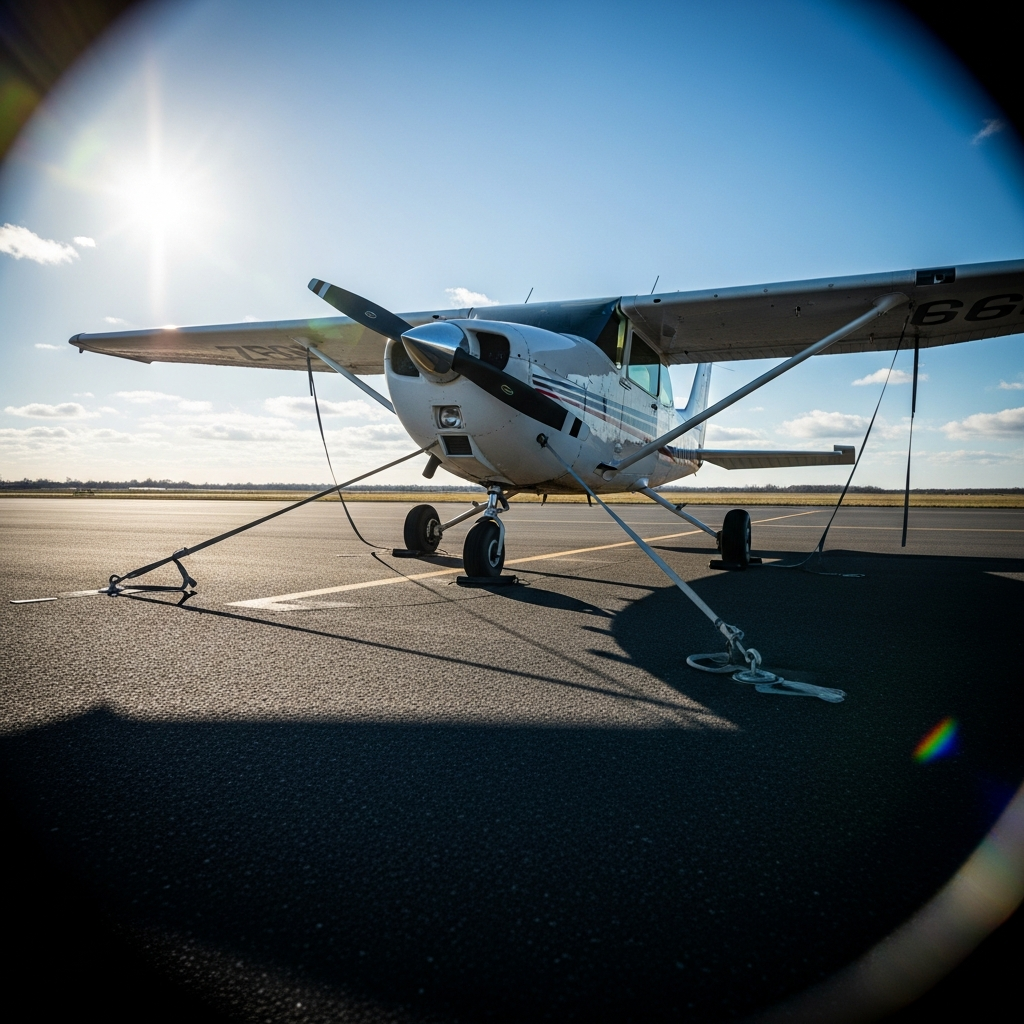
Transient parking at unfamiliar airports is one of those situations where proper tie-down equipment can make the difference between finding your airplane where you left it and filing an insurance claim. Wind conditions, ramp surface quality, and the availability of airport-provided hardware vary enormously from field to field, and relying on whatever rusty eyebolts a rural FBO has lying around is a gamble no careful pilot should take. Carrying your own tie-down kit adds only a few pounds to your baggage, but it buys genuine peace of mind whether you’re overnighting at a busy Class D or parked on a grass strip in the middle of nowhere.
This guide is aimed at owners and regularly flying pilots of single-engine and light twin Cessnas, Pipers, and Beechcrafts — the aircraft most commonly left unattended on transient ramps. The products below cover a range of budgets and use cases, from ultralight spiral anchors ideal for soft-surface fields to heavy-duty kitted solutions built for serious storm exposure. All are designed to work with your existing tie-down rings and a set of ropes or straps you likely already carry.
Our top picks at a glance:
| Product | Best For | Price |
|---|---|---|
| The Claw Tie-Down | Heavy-duty clamping without knots | Check Price → |
| Storm Force Tie-Down Kit | Complete multi-strap securing system | Check Price → |
| FlyTies Aircraft Tie-Down Straps | Quick-release strap-based tie-downs | Check Price → |
| DeGroff EZ-Lock Tie-Down | Fast locking mechanism securing | Check Price → |
| Keeper Cable Aircraft Tie-Down Cables | Durable cable-based aircraft restraint | Check Price → |
The Claw Tie-Down
The Claw has earned a loyal following among GA pilots for good reason: its corkscrew-style ground anchor is engineered to grip a wide variety of surfaces, from packed gravel to soft turf, without requiring a mallet or special tools. You twist it in by hand or with a simple bar through the eye, and the helical design resists pullout forces in multiple directions — important when gusts shift. It’s a compact, self-contained solution that fits easily in a flight bag, and the build quality is noticeably above bargain-bin spiral stakes.
The Claw suits pilots who frequently land at grass or unpaved strips where pavement tie-down rings simply don’t exist. On hard ramp surfaces it’s less useful unless rings are present, so it’s best thought of as a soft-field specialist or a supplement to a standard rope kit rather than a standalone all-surface solution. The trade-off is price — it sits above entry-level anchors — but for tail-down overnights at rural strips it’s hard to beat.
Check The Claw aircraft tie-down ground anchor price on Amazon →
Storm Force Tie-Down Kit
As the name suggests, the Storm Force kit is built with serious weather in mind. This is a more comprehensive package that typically includes heavy-duty anchors, reinforced straps or ropes, and hardware rated for higher load ratings than casual tie-down stakes. For pilots who fly into coastal areas, the Gulf States, or anywhere convective weather can develop quickly and severely, having a kit explicitly designed around storm loads is worth the investment. The components are matched to work together, which removes the guesswork of assembling a piecemeal system.
The Storm Force kit is heavier and bulkier than minimalist options, so it’s better suited to owners who drive to the airport rather than those trying to keep baggage weight to a minimum on a cross-country. It’s also a strong choice for aircraft owners who leave planes parked away from home base for extended periods, where a sudden frontal passage could put unattended equipment to the test. Expect a higher price point relative to basic kits, but the engineering behind storm-rated hardware justifies the cost when conditions turn ugly.
Check Storm Force aircraft tie-down kit price on Amazon →
FlyTies Aircraft Tie-Down Straps
FlyTies takes a strap-based approach rather than relying solely on traditional rope, which offers some genuine advantages: consistent tension, no knot-tying fumbling in the dark or cold, and resistance to the loosening that natural-fiber ropes can suffer after a rain. The integrated ratchet or cam-buckle mechanism (depending on the version) makes achieving proper tension straightforward even for less experienced pilots, which is an underrated safety factor — an improperly tensioned rope tie-down can be nearly as dangerous as no tie-down at all.
FlyTies works best at airports with established pavement tie-down rings, as the straps are designed to connect fixed points rather than act as ground anchors themselves. For the pilot who mostly parks at paved transient ramps and wants a lightweight, repeatable system that packs flat and stows easily, FlyTies is an excellent everyday carry. The trade-off compared to heavier kits is that they’re not a solution for soft-field anchoring without supplemental ground hardware.
Check FlyTies aircraft tie-down straps price on Amazon →
DeGroff EZ-Lock Tie-Down
The DeGroff EZ-Lock system is built around a quick-connect locking mechanism that snaps onto standard tie-down rings without threading knots or wrestling with hardware in awkward positions under a wing. For pilots who tie down frequently — flight school instructors, high-cycle renters, or owners doing multiple legs a day — the time savings and reduced frustration add up quickly. The locking action also provides a more positive, tamper-resistant connection than a simple rope loop, which matters on public ramps where a carelessly loosened knot by a passerby is a real possibility.
The EZ-Lock excels as a ramp-surface tie-down tool and is particularly well regarded for its durability and corrosion resistance in marine or high-humidity environments. Like FlyTies, it depends on existing anchor points, so it pairs well with spiral ground anchors if you fly into soft fields. Pilots who prioritize speed and simplicity over all other considerations will find the EZ-Lock system one of the most operationally convenient options on the market.
Check DeGroff EZ-Lock aircraft tie-down price on Amazon →
Keeper Cable Aircraft Tie-Down Cables
A well-known alternative worth including, Keeper Cable-style aircraft tie-down cables offer a steel-cable construction that adds a security dimension beyond weather protection — cable is significantly harder to cut or deter than rope or nylon strap. For transient parking at airports where theft of small aircraft components or even aircraft movement by unauthorized persons is a concern, the added resistance to tampering is a genuine advantage. Stainless or coated steel cables also hold up extremely well to UV, moisture, and temperature cycling that can degrade synthetic straps over time.
The trade-off is weight and the fact that cables require careful coiling to avoid kinking, and they’re less forgiving than rope if overtensioned. They’re best suited for pilots who regularly park in metropolitan areas or leave aircraft unattended for days at a time rather than for quick overnight stops at quiet rural strips.
Check aircraft tie-down security cable kit price on Amazon →
How to Choose
The right tie-down kit depends heavily on where and how you fly. A pilot who sticks to paved airports with fixed rings needs a very different solution than one who regularly explores backcountry grass strips. Think through your typical mission profile before buying.
- Surface type: Paved ramps with existing rings call for straps or cable systems; unpaved or soft surfaces require ground anchors like spiral stakes.
- Weather exposure: If you operate in storm-prone regions or leave aircraft parked for extended periods, prioritize higher load ratings and purpose-built storm kits.
- Weight and portability: Pilots managing weight budgets carefully should favor compact strap systems; those with room to spare can carry more robust anchor kits.
- Ease of use: Quick-connect mechanisms reduce errors in darkness, cold, or fatigue — a genuine safety consideration, not just a convenience.
- Security concerns: For metropolitan or unattended long-term parking, steel cable systems provide an added layer of tamper resistance.
FAQ
How many tie-down points does a typical light single need?
Most Cessna, Piper, and Beechcraft singles have three standard tie-down points — two under the wings and one at the tail — and all three should be used whenever conditions warrant. Tying only the wings in gusty conditions can allow the tail to lift, which creates a dangerous lever effect on the entire airframe.
Can I use hardware-store rope for aircraft tie-downs?
Polypropylene or manila rope from a hardware store is better than nothing, but it’s not ideal. These materials can degrade faster under UV exposure, stretch unpredictably when wet, and may not carry consistent load ratings. Aviation-specific ropes, straps, and cables are designed and rated for the loads a wind-struck aircraft can generate, which is considerably more than most people intuitively expect.
Do tie-down kits expire or need regular inspection?
Yes — inspect your kit before every use and replace any component showing fraying, corrosion, cracking, UV degradation, or deformation in metal hardware. Synthetic straps in particular degrade with UV exposure over time even if they look intact externally. Most manufacturers recommend periodic replacement rather than using gear indefinitely, especially for equipment relied upon in high-wind situations.