As an Amazon Associate, Zulu Parts earns from qualifying purchases. Prices and availability are accurate as of the time of purchase.
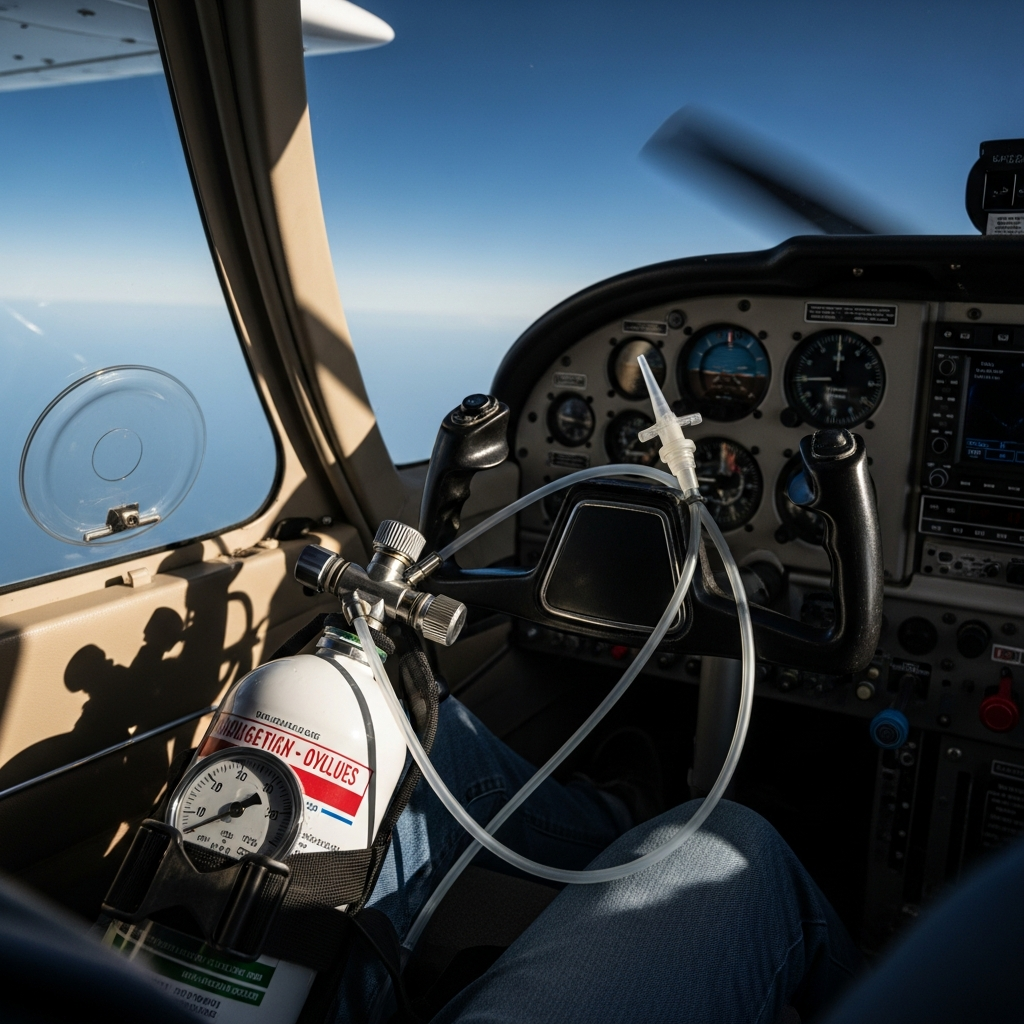
Flying above 10,000 feet MSL without supplemental oxygen isn’t just uncomfortable — it’s a genuine safety hazard that develops faster than most pilots expect. Hypoxia is insidious, impairing judgment and reaction time well before you notice any symptoms, and the FARs set minimums (15,000 feet without exception, 12,500 feet after 30 minutes) that many experienced pilots consider far too conservative to rely on as a personal limit. If you regularly fly in the flight levels, cross mountainous terrain, or operate a pressurized or unpressurized single or twin in the high teens, a portable oxygen system is one of the most worthwhile investments you can make in your cockpit.
This guide is written for owner-pilots of Cessna 172s through 210s, Piper Arrows, Saratogas, Senecas, Beechcraft Bonanzas, and similar general-aviation aircraft — aircraft that may or may not have factory oxygen provisions. The products below range from simple canned solutions for occasional excursions to serious electronic pulse-demand systems for IFR pilots who regularly cruise above 12,500 feet. All are genuinely available in the GA market; none require an A&P for installation in portable form.
Our top picks at a glance:
| Product | Best For | Price |
|---|---|---|
| Mountain High O2D2 Portable Oxygen System | Portable oxygen delivery for high altitude flying | Check Price → |
| Aithre Shield Aviation Pulse Oximeter and Oxygen Monitor | Real-time oxygen saturation monitoring during flight | Check Price → |
| Boost Oxygen Portable Canned Oxygen | Emergency supplemental oxygen for quick access | Check Price → |
| Precise Flight Standby Oxygen System | Certified standby oxygen system for aircraft | Check Price → |
| Mountain High XCR Pulse Oximeter | Portable pulse oximetry without integrated oxygen | Check Price → |
Mountain High O2D2 Portable Oxygen System
The Mountain High O2D2 (Oxygen Demand Diluter) is widely regarded as the gold standard in portable GA oxygen delivery. It uses a sophisticated electronic pulse-demand delivery system that reads your breathing rate and pulse-oximetry data, then meters oxygen precisely at the start of each inhale rather than flowing continuously — which means a standard cylinder lasts dramatically longer than with constant-flow equipment. The unit pairs with Mountain High’s XCR pulse oximeter and can support multiple users simultaneously, making it a legitimate solution for pilot and passenger alike on longer cross-countries above the teens.
The trade-off is cost and complexity relative to simpler systems. The O2D2 is an investment, and the electronics mean you have one more item to preflight and keep charged. That said, for any pilot who flies regularly above 12,500 feet in an unpressurized aircraft, the efficiency and the built-in SpO2 monitoring make this the most capable portable option on the market. It is not a casual purchase — it is purpose-built professional equipment.
Check Mountain High O2D2 portable aviation oxygen system price on Amazon →
Aithre Shield Aviation Pulse Oximeter and Oxygen Monitor
The Aithre Shield takes a different but equally important approach: rather than supplying oxygen itself, it provides continuous Bluetooth-connected pulse oximetry that streams your SpO2 and heart rate directly to an iPad running ForeFlight, Garmin Pilot, or the dedicated Aithre app. For pilots who already have a certified or portable oxygen system installed, the Shield closes the monitoring loop — you get a cockpit alert the moment your blood oxygen begins to drop, rather than waiting until impairment has already begun. The Bluetooth connectivity and ForeFlight integration make it exceptionally clean to use in a glass-panel or EFB-equipped cockpit.
The Shield is not a replacement for a delivery system; it is a companion to one, or a standalone early-warning tool for pilots who want objective data at lower altitudes where supplemental O2 is not yet required. It is compact, wearable, and requires no FAA approval as a monitoring-only device. Pilots who combine the Aithre Shield with any of the delivery systems in this guide have a genuinely complete oxygen-management solution.
Check Aithre Shield aviation pulse oximeter Bluetooth price on Amazon →
Boost Oxygen Portable Canned Oxygen
Boost Oxygen occupies a very different niche from the systems above. These are pre-filled, lightweight canisters of supplemental oxygen — no regulator, no cylinder hydro, no pulse-demand electronics. For a VFR pilot who occasionally crosses a mountain range or encounters an unexpected altitude excursion, a couple of Boost Oxygen canisters in the flight bag provide a meaningful emergency buffer. They are available in sport and large sizes and require no special storage approvals for portable use in a small aircraft.
Be clear-eyed about the limitations: Boost Oxygen canisters are not a substitute for a regulated oxygen system on sustained high-altitude operations. The volume per canister is modest, delivery is not metered for altitude, and they are best thought of as a short-duration supplement or an emergency backup rather than primary IFR oxygen equipment. For a student pilot heading over the Rockies or a weekend flyer making a single high-altitude crossing, however, they are an accessible and genuinely useful safety item with essentially zero setup complexity.
Check Boost Oxygen portable canister supplemental oxygen price on Amazon →
Precise Flight Standby Oxygen System
Precise Flight has been a trusted name in GA oxygen equipment for decades, and their Standby Oxygen Systems are designed specifically for use in certificated aircraft as portable or semi-permanent installations. Precise Flight systems use continuous-flow delivery through standard aviation cannulas and are compatible with the company’s line of regulators and cylinders. They are a practical choice for Cessna and Beechcraft owners who want an orthodox, well-supported oxygen solution with readily available replacement parts and a long service history in the type clubs.
Continuous-flow delivery is less oxygen-efficient than pulse-demand at altitude, meaning cylinder duration is shorter for equivalent use — this is the primary trade-off versus the Mountain High O2D2. However, the technology is simpler, the system is easy to operate under workload, and Precise Flight’s customer support and documentation for GA aircraft are excellent. For a Bonanza or Cessna 210 owner who flies in the mid-teens occasionally and wants reliable, uncomplicated oxygen capability, Precise Flight remains a thoroughly sound choice.
Check Precise Flight standby oxygen system general aviation price on Amazon →
Mountain High XCR Pulse Oximeter
For pilots already using a Mountain High delivery system, or anyone who wants a dedicated wrist-worn aviation pulse oximeter, the Mountain High XCR is purpose-built for the cockpit environment. Unlike consumer fitness oximeters, it is designed to function accurately under vibration and variable lighting, and it integrates directly with Mountain High’s O2D2 system to provide closed-loop oxygen management. The display is readable in direct sunlight, and the device can alert you to dropping SpO2 before symptoms appear.
As a standalone monitor, the XCR is a strong pick for pilots who want hardware purpose-designed for aviation rather than adapted from a consumer product. It does not have the Bluetooth/EFB integration of the Aithre Shield, so your choice between the two may come down to whether you prefer a wrist display or cockpit-app integration. Either way, pairing an oximeter with your delivery system is a best practice, not a luxury.
Check Mountain High XCR pulse oximeter aviation price on Amazon →
How to Choose
The right portable oxygen system depends primarily on how often you fly at altitude, how many occupants need coverage, and how much you value delivery efficiency versus simplicity. Here are the key factors to weigh before purchasing:
- Delivery method: Pulse-demand systems (Mountain High O2D2) are far more efficient with oxygen supply than continuous-flow (Precise Flight), making them superior for extended high-altitude operations.
- Number of users: Some systems support one user; others can feed pilot and passengers simultaneously. Confirm crew capacity before buying.
- Monitoring integration: A delivery system without SpO2 monitoring is flying partially blind. Budget for an oximeter — Aithre Shield for EFB integration, Mountain High XCR for standalone wrist display.
- Frequency of use: For rare altitude excursions, Boost Oxygen canisters or a simple continuous-flow setup may be entirely adequate. For regular IFR flight above 12,500 feet, invest in a full pulse-demand system.
- Cylinder logistics: Consider how you will have cylinders refilled or swapped in your home area, and whether the system uses standard industrial/medical fittings or proprietary connections.
FAQ
At what altitude should I start using supplemental oxygen?
The FARs require flight crew oxygen use above 12,500 feet MSL after 30 minutes, and above 14,000 feet at all times. Most aviation medical professionals recommend beginning supplemental oxygen at or below 10,000 feet, particularly at night when dark-adaptation is already reducing night vision. Many experienced high-altitude pilots use oxygen from 8,000–9,000 feet onward during long flights.
Do portable oxygen systems require FAA approval to use in my aircraft?
Truly portable oxygen equipment — meaning it is not permanently installed and does not penetrate the aircraft structure — generally does not require a Supplemental Type Certificate or Form 337. However, you should confirm with your A&P and review your aircraft’s POH and any applicable ADs before using any oxygen equipment in flight. Permanently plumbed systems are a different matter and do require approved installation.
How long does a portable oxygen cylinder typically last?
Duration varies significantly by cylinder size, altitude, number of users, and delivery method. A pulse-demand system can extend cylinder life two to four times compared with continuous flow at the same altitude. As a general rule, always calculate your expected cylinder duration for the planned flight and carry reserve. Most portable GA cylinders are rated in cubic feet; your system’s documentation will provide duration tables by altitude and flow setting.