As an Amazon Associate, Zulu Parts earns from qualifying purchases. Prices and availability are accurate as of the time of purchase.
Every preflight checklist has it: sump the tanks, check for water and sediment, confirm the right fuel grade. It sounds routine until the day your tester pulls a slug of water or reveals avgas in a jet-only airframe — and suddenly that thirty-second habit is the reason you’re walking away from the flight instead of the airplane. A quality fuel tester lets you see color, clarity, and contamination quickly and reliably, and it needs to hold up to repeated exposure to 100LL and Jet-A without cracking, clouding, or leaching residue into the sample.
This guide is aimed at owner-operators and student pilots flying piston singles and light twins — Cessnas, Pipers, Beechcrafts — who sump their own aircraft and want a tester that actually does the job. Whether you’re looking for the classic go-to jar, a combined drain-and-check tool, or something that handles awkward sump ports, there’s a right choice for your aircraft type and your preflight habits.
Our top picks at a glance:
| Product | Best For | Price |
|---|---|---|
| GATS Jar | Visual fuel contamination inspection | Check Price → |
| ASA AFT-1 Aviation Fuel Tester | Professional water detection testing | Check Price → |
| MultiSump Fuel Tester | Multiple aircraft fuel sampling | Check Price → |
| SamplerCup Aviation Fuel Tester | Portable fuel quality checks | Check Price → |
| Spill-Safe Aviation Fuel Drain Tester with Sump Tube | Mess-free fuel contamination sampling | Check Price → |
GATS Jar
The GATS (General Aviation Training Supplies) Jar is arguably the most widely recognized fuel tester in piston GA. Its large-capacity clear container gives you an excellent view of fuel color and makes spotting water globules or particulate matter straightforward in most lighting conditions. The screened drain at the bottom means you can safely dispose of the sample back through a chamois or strainer into an approved container, which is a real convenience at busy flight schools and FBOs where spilling 100LL on the ramp is a liability concern.
The GATS Jar is best suited to standard Cessna-style sumps with the protruding drain pin. Its generous volume lets you pull enough fuel to confidently check a deep sump. The main trade-off is bulk — it’s larger than slip-in-pocket alternatives — but most pilots stow it in a flight bag side pocket without issue. If you fly a Cessna 172, 182, or similar, this is the tester most CFIs will already have on the ramp.
Check GATS Jar aviation fuel tester price on Amazon →
ASA AFT-1 Aviation Fuel Tester
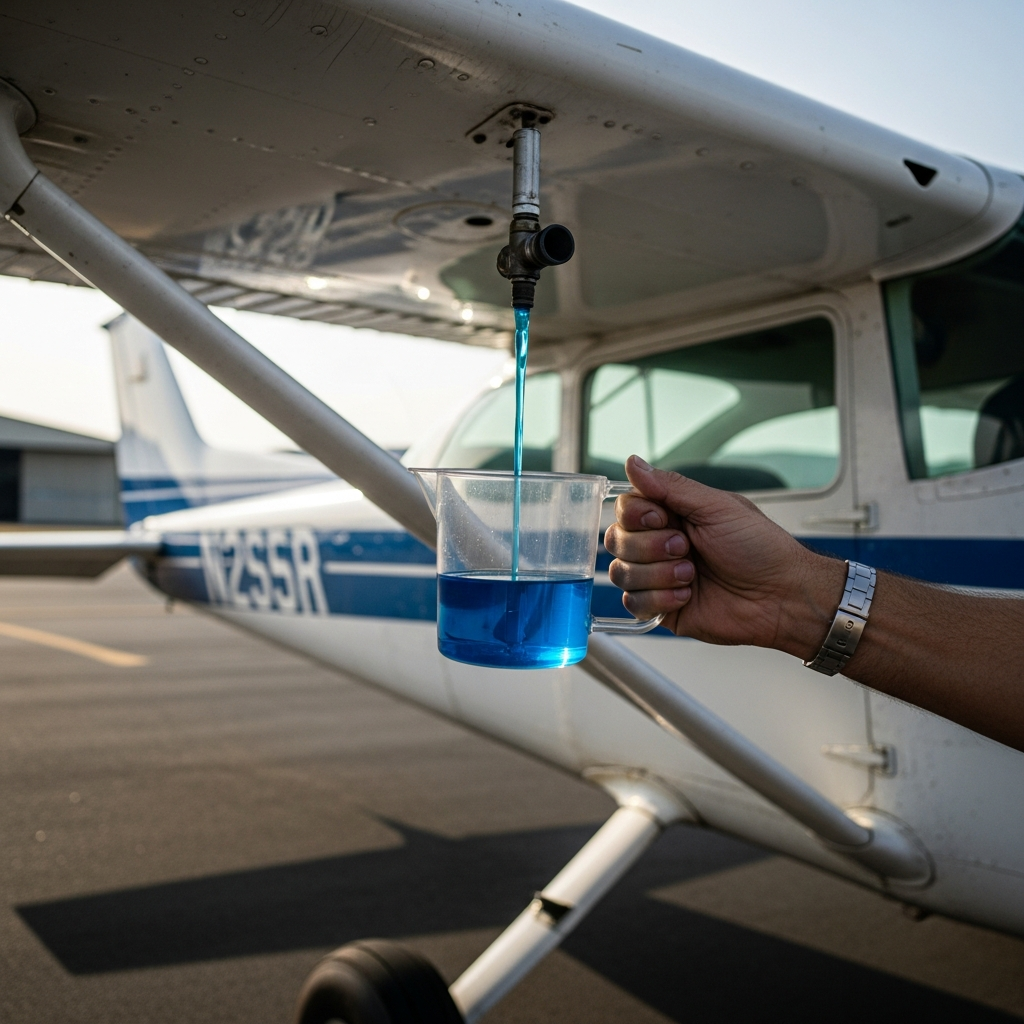
ASA’s AFT-1 is a compact, purpose-built tester with a clear acrylic body and a spring-loaded center probe designed to fit the standard GA sump drain. Its slim profile means it tucks easily into a flight bag or even a shirt pocket, which matters during a thorough preflight when you’re moving around the airplane quickly. The transparency of the acrylic gives good color discrimination — particularly useful when you need to distinguish between the blue tint of 100LL and clear Jet-A, or when checking for that telltale water meniscus at the bottom of the sample.
The AFT-1 is a solid everyday workhorse, especially for pilots who prioritize portability. It is best matched to standard drain-valve style sumps rather than recessed or non-standard ports. Some pilots find the capacity on the smaller side for deep tank sumps, but for routine preflight use on most Cessna and Piper models it performs reliably. It’s a popular choice as a first dedicated fuel tester for student pilots because of its low cost and ease of use.
Check ASA AFT-1 aviation fuel tester price on Amazon →
MultiSump Fuel Tester
The MultiSump is designed specifically to address the frustration of aircraft with multiple sump drain configurations. Where many testers work well on standard Cessna-style drains but struggle with Piper-style recessed sumps or Beechcraft drain locations, the MultiSump is engineered with interchangeable or multi-fit tips that can engage different drain valve types without improvisation. This versatility makes it particularly valuable if you fly more than one type of aircraft, fly club-owned mixed fleets, or own a Piper Cherokee, Archer, or Beechcraft Bonanza where sump access geometry differs from the Cessna norm.
The clear body provides adequate sample visibility for water and sediment checks, and the overall build quality is intended for repeated ramp use. The trade-off relative to simpler testers is slightly more complexity in cleaning and maintaining the multi-tip configuration, and it may be more than a single-type owner needs. For mixed-fleet operators and flight schools running both Cessnas and Pipers, it can eliminate the need to carry two different testers.
Check MultiSump aviation fuel tester multi-aircraft price on Amazon →
SamplerCup Aviation Fuel Tester
The SamplerCup takes a minimalist approach: a clear, lightweight cup with a simple drain probe that gets the fundamental job done without extra features. Its transparency is adequate for color and water checks, and the open-top cup design makes it very easy to visually inspect the fuel from multiple angles, which some pilots prefer over a closed-body tester. It’s also easy to rinse and keep clean. For student pilots or owners who want an inexpensive, fuss-free backup tester to keep in a flight bag alongside a primary tool, it fits that role well.
The SamplerCup is not the choice for awkward sump locations or deep-sump tanks where you need significant sample volume. It also offers fewer safeguards against spilling a sample on the ramp, which matters for environmental compliance at some airports. Think of it as a reliable, no-frills option rather than a do-everything tool — best for standard drains on straightforward airframes where simplicity is the priority.
Check SamplerCup aviation fuel tester preflight price on Amazon →
Spill-Safe Aviation Fuel Drain Tester with Sump Tube
For pilots who regularly deal with recessed or hard-to-reach sumps — particularly common on low-wing aircraft like the Piper Cherokee series where you’re reaching up into the wing root — a tester with an extended sump tube can make the difference between a proper sample and an awkward reach that results in fuel on your arm or an incomplete check. Extended-tube designs keep your hand away from the drain stream and let you collect a meaningful sample from difficult angles. Some versions also incorporate a closed or semi-closed design to reduce spill risk.
The trade-off is that long-tube testers are harder to pocket and require more careful cleaning to prevent fuel residue buildup inside the tube. They earn their place in any kit used on low-wing aircraft and are worth carrying as a complement to a standard tester if your fleet includes both high- and low-wing types.
Check aviation fuel tester extended sump tube low wing price on Amazon →
How to Choose
The right fuel tester depends on the aircraft you fly, how often you sump, and practical factors like where you carry it. Consider these decision points before buying:
- Aircraft sump type: Cessna high-wings typically use a standard protruding drain pin; Piper low-wings and Beechcraft models often use recessed or different-geometry drains. Confirm your aircraft’s sump style before choosing a tester with a fixed probe design.
- Sample visibility: Clear acrylic or polycarbonate bodies are essential. Thicker-walled or larger-capacity containers make it easier to see water separation and assess color in bright ramp lighting.
- Portability vs. capacity: Compact testers are convenient but may not pull enough volume from deep sumps. If you’re sumping large tanks or performing a thorough contamination check, capacity matters.
- Spill management: Testers with screened or controlled drains let you return fuel to an approved container rather than spilling on the ramp — an important consideration at environmentally regulated airports.
- Fleet compatibility: If you fly multiple aircraft types or instruct in a mixed fleet, a multi-fit or multi-tip tester saves time and eliminates the need for multiple tools.
FAQ
How much fuel should I sump from each drain point?
A commonly taught practice is to draw enough fuel to clearly see the color and to allow any water — which sinks below avgas — to separate visibly in the tester. A full tester cup or jar is generally sufficient for a clear visual check. Always follow your aircraft’s POH and your flight school or operator’s procedures for specific guidance.
Can I put the sampled fuel back in the tank?
Only if it is confirmed uncontaminated and the tester itself is clean. Testers with a screened or filtered drain — like the GATS Jar used with an appropriate chamois — are designed to facilitate safe return of uncontaminated fuel. Never return fuel that showed any sign of water or debris, and always use a clean, approved container or filter if returning fuel to the aircraft.
How do I tell water from fuel in the tester?
Water is denser than avgas and will settle to the bottom of the sample as a distinct clear or slightly cloudy layer with a visible meniscus separating it from the blue-tinted fuel above. Even a small amount of water is cause to re-sump until samples are clear. If water persists, ground the aircraft and have the fuel system inspected before flight.