As an Amazon Associate, Zulu Parts earns from qualifying purchases. Prices and availability are accurate as of the time of purchase.
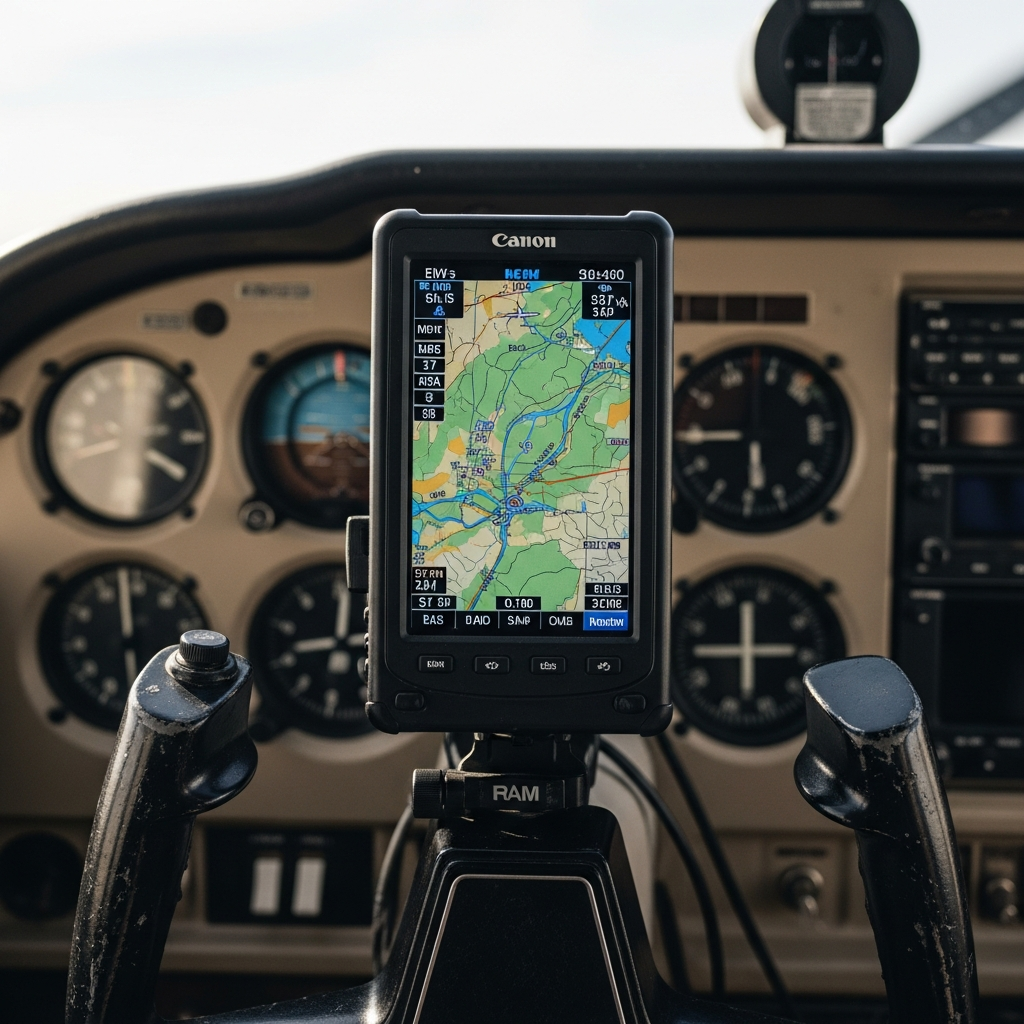
A reliable handheld aviation GPS can be the difference between a confident cross-country and a stressful one. Whether you’re flying a well-equipped Cessna 172 with a glass panel or an older Piper Cherokee with a basic stack, a portable GPS gives you situational awareness that supplements — and sometimes surpasses — what’s installed on the panel. For student pilots building cockpit familiarity, backcountry flyers who need terrain awareness, or owners of older GA aircraft who aren’t ready to commit to an expensive panel upgrade, a handheld unit delivers a remarkable amount of capability for a relatively modest investment.
The market for portable aviation GPS has matured considerably, and today’s options range from current-generation touchscreen units packed with weather and traffic features to well-loved legacy devices that still earn their place in the flight bag. This guide covers the strongest options available — including a classic that refuses to retire — so you can match the right unit to your flying style and budget.
Our top picks at a glance:
| Product | Best For | Price |
|---|---|---|
| Garmin aera 760 | Advanced aviation with touchscreen display | Check Price → |
| Garmin aera 660 | Mid-range aviation GPS with reliability | Check Price → |
| Garmin GPSMAP 296 (Used) | Budget aviation GPS option | Check Price → |
| Garmin GPSMAP 695/696 | Integrated panel-mount aviation navigation | Check Price → |
| Bad Elf GNSS Performer | Portable external GNSS receiver | Check Price → |
Garmin aera 760
The Garmin aera 760 sits at the top of the current portable GPS lineup for good reason. Its large 7-inch sunlight-readable touchscreen makes it genuinely usable in bright cockpit conditions, and the portrait-or-landscape mounting flexibility suits a wide range of aircraft interiors. It supports Garmin’s Smart Airspace feature for automatic Class B/C/D highlighting, and when paired with a compatible ADS-B receiver it can display FIS-B weather and TIS-B traffic — giving you a near-panel-level picture without the panel-level price tag.
The aera 760 is best suited to pilots who fly frequently and want their portable unit to carry real workload. The larger screen size makes route planning and terrain awareness notably easier than smaller units, though that size can be a mild inconvenience in tight panel spaces or when stowing the unit. Battery life is reasonable for most cross-country legs, and the unit accepts Garmin Pilot subscription content seamlessly for those already in that ecosystem.
Check Garmin aera 760 aviation GPS price on Amazon →
Garmin aera 660
The Garmin aera 660 is the more compact sibling to the 760, built around a 5-inch touchscreen that strikes a practical balance between readability and portability. It covers all the core bases: Garmin’s aviation database, georeferenced approach charts, terrain awareness, and ADS-B weather and traffic capability when paired with an external receiver. For pilots who want a capable unit that tucks into a flight bag without any drama, the 660 hits the sweet spot.
Where the 660 gives ground to the 760 is simply screen real estate — splitting the display between a moving map and a second data field is more cramped, and pilots with older eyes may prefer the larger format. That said, for a Piper Archer or Beechcraft Bonanza owner who wants a clean, capable portable without a large suction-cup mount dominating the windshield, the aera 660 is an excellent and genuinely well-thought-out choice. It’s one of the most popular handheld aviation GPS units for good reason.
Check Garmin aera 660 aviation GPS price on Amazon →
Garmin GPSMAP 296 (Used)
The Garmin GPSMAP 296 is a legacy unit that preceded touchscreen displays and modern ADS-B integration, yet it maintains a devoted following among GA pilots for good reasons. Its button-driven interface is operable without looking down, a trait some pilots genuinely prefer over touchscreens in turbulence. The color moving map, terrain warning, and XM weather capability (where still functional) made it a benchmark product in its era, and units in good condition remain useful for VFR navigation and situational awareness.
Buying used requires some caution: database subscriptions are no longer updated by Garmin, so treat any installed database as an awareness tool rather than a primary navigation reference — always cross-check against current charts. Battery and hardware condition vary widely on the used market. That said, for a student pilot who wants to build moving-map habits without significant expense, or an owner wanting a backup device with proven reliability, a well-maintained GPSMAP 296 at a reasonable used price still earns its spot in the flight bag.
Check Garmin GPSMAP 296 aviation GPS used price on Amazon →
Garmin GPSMAP 695/696
Bridging the gap between the aging 296 era and today’s touchscreen generation, the Garmin GPSMAP 695 and 696 offer a large display and a hybrid button-plus-touchscreen interface that many pilots find highly intuitive. The 696 in particular features a generous screen size and terrain awareness that was considered class-leading at its release. Used examples are widely available and often represent strong value for owners of older Cessna or Beechcraft aircraft who want a capable color moving map without paying for a brand-new unit.
As with the 296, databases are no longer actively updated, so the same advisory applies: use current paper or EFB charts as your primary reference and treat the GPS as a situational awareness supplement. Hardware reliability on well-cared-for units is generally good, and the larger display makes this an appealing choice as a secondary cockpit display or primary portable for VFR-focused flying.
Check Garmin GPSMAP 696 aviation GPS price on Amazon →
Bad Elf GNSS Performer
The Bad Elf GNSS Performer takes a different approach entirely — it’s a high-sensitivity GPS receiver designed to pair with an iPad or tablet running a full-featured EFB app such as ForeFlight or Garmin Pilot. Rather than being a standalone display unit, it improves the GPS accuracy and reliability of your tablet setup, particularly for faster aircraft or situations where the iPad’s internal GPS struggles. For pilots already deeply invested in the tablet-plus-app workflow, this is a cost-effective way to bring dedicated aviation-grade position quality to that setup.
This is not a standalone replacement for a traditional handheld GPS — it depends entirely on your tablet and app remaining functional. But for Cessna 182 or Piper Comanche owners who fly with an iPad as their primary EFB and want improved GPS performance without buying a full handheld unit, the Bad Elf GNSS Performer is a smart, focused purchase.
Check Bad Elf GNSS Performer aviation GPS receiver price on Amazon →
How to Choose
The right handheld GPS depends heavily on how you fly, what’s already in your cockpit, and how much redundancy you want to build into your avionics setup. Consider these factors carefully before purchasing:
- Database currency: Current-generation units (aera 660, aera 760) support ongoing database subscriptions. Legacy units do not — factor in whether you’ll rely on the GPS database or supplement with a current EFB app.
- Screen size vs. cockpit space: A 7-inch display is easier to read but occupies more panel or yoke space. Measure your intended mounting location before committing to a larger unit.
- ADS-B integration: If you want weather and traffic on your portable, ensure the unit supports an external ADS-B receiver, or budget for a compatible receiver alongside it.
- Standalone vs. tablet companion: Decide whether you want a fully self-contained GPS unit or a receiver that enhances an existing iPad/EFB workflow — both are valid, but they serve different needs.
- New vs. used: Used legacy units offer significant savings but come with database limitations and hardware uncertainty. Buy from a reputable seller and verify hardware condition carefully.
FAQ
Can I use a handheld GPS as my primary navigation device legally?
For VFR flight, a handheld GPS can supplement your navigation, but regulations require you carry current charts for the airspace you’re operating in. It is not certified as a primary IFR navigation source unless specifically approved. Always check current FAA regulations and your aircraft’s AFM for guidance.
Do I need a separate ADS-B receiver for weather and traffic?
Yes — units like the Garmin aera 660 and aera 760 display ADS-B weather (FIS-B) and traffic (TIS-B), but they require a compatible external ADS-B receiver to do so. The GPS itself does not include a built-in ADS-B receiver. Garmin’s GDL 52 and similar units are common pairings.
Is a used Garmin GPSMAP 296 or 696 worth buying in 2024?
For VFR situational awareness as a backup or learning tool, yes — provided you buy a unit in good hardware condition and understand that the aviation databases are no longer updated. Always cross-reference with current charts or a current EFB app, and treat the legacy GPS as an awareness supplement rather than a sole navigation reference.