As an Amazon Associate, Zulu Parts earns from qualifying purchases. Prices and availability are accurate as of the time of purchase.
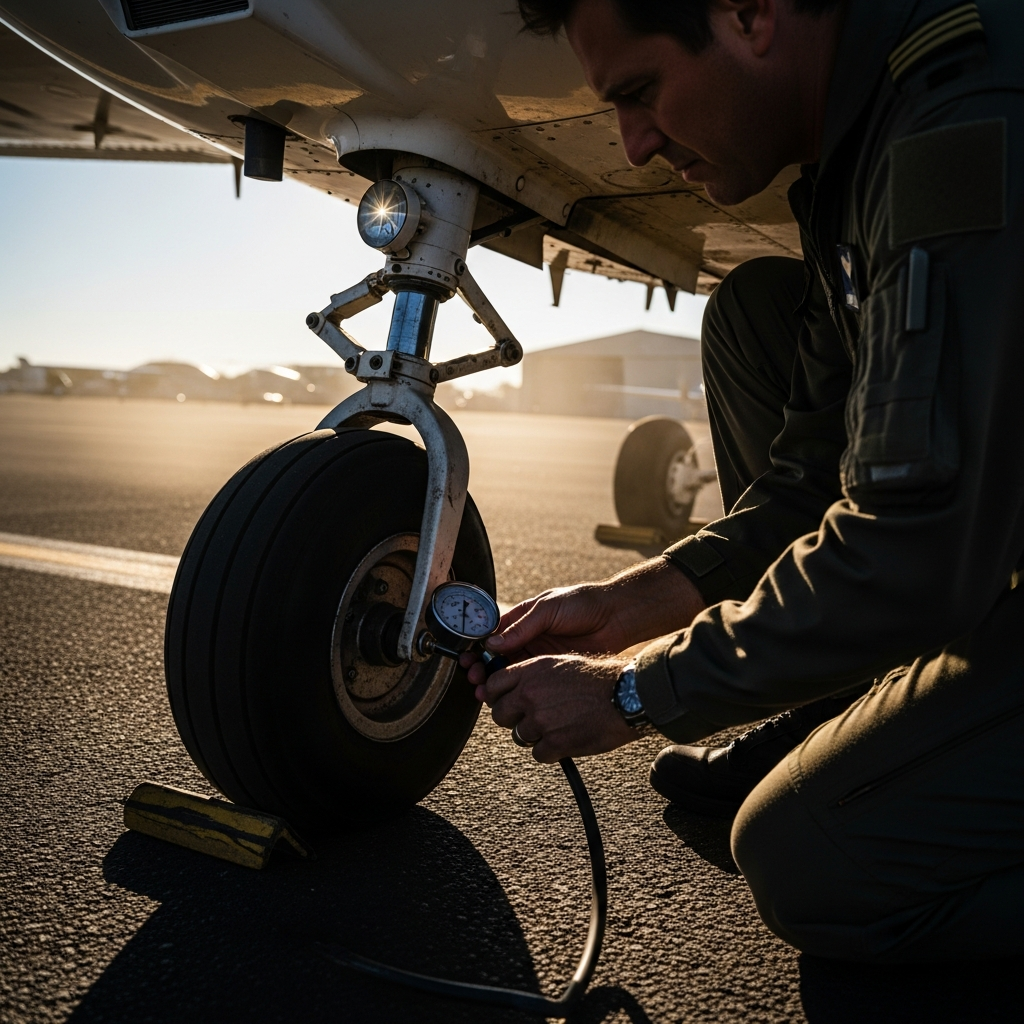
Aircraft tires operate at significantly higher pressures than typical automotive tires — main gear tires on a Cessna 172 run around 42 psi, while Piper Cherokee nose tires and Beechcraft Bonanza main gear can push well above 60 psi. Using an automotive gauge that tops out at 50 psi or loses accuracy in the upper range isn’t just inconvenient, it’s a maintenance hazard. Proper inflation directly affects ground handling, tire wear, and — critically — the energy absorbed during landing. Under-inflated tires flex excessively and overheat; over-inflated tires reduce the contact patch and increase blowout risk on rough runways.
This guide is aimed at owner-operators of piston singles and light twins who handle their own preflight checks and routine maintenance under their A&P’s supervision, as well as line service personnel and flight schools keeping a fleet airworthy. The tools below range from precision dial gauges you’ll keep in your flight bag to dedicated inflators built for the ramp. Every product listed works reliably in the pressure ranges real GA aircraft actually demand.
Our top picks at a glance:
| Product | Best For | Price |
|---|---|---|
| PCL Aircraft Tire Inflator | Aircraft tire inflation and pressure control | Check Price → |
| ASA Tire Pressure Gauge | Aviation standard tire pressure measurement | Check Price → |
| Michelin High-Pressure Tire Gauge | High-pressure aircraft tire readings | Check Price → |
| AccuGage High-Pressure Tire Gauge | Accurate high-pressure gauge applications | Check Price → |
| Milton Industries Dial Tire Gauge (High-Pressure) | Mechanical high-pressure dial gauge measurement | Check Price → |
PCL Aircraft Tire Inflator
PCL is widely regarded as the professional standard for aircraft tire inflation equipment, and their inflators are a common sight at FBOs and flight schools worldwide. Built around a sturdy metal chuck and a robust regulator body, PCL inflators are designed specifically for the higher-pressure, higher-volume demands of aircraft tires — not repurposed automotive tools. The integrated gauge reads clearly, and the locking chuck style reduces air loss during connection, which matters when you’re trying to hit a precise target pressure rather than just “close enough.”
The trade-off is cost: PCL equipment sits at the higher end of the price range and is more appropriate for frequent shop or line-service use than for a private owner who checks pressures once a week. If you’re running a flight school or maintaining multiple aircraft, the durability justifies the investment quickly.
Check PCL aircraft tire inflator price on Amazon →
ASA Tire Pressure Gauge
Aviation Supplies & Academics (ASA) produces a dedicated aircraft tire pressure gauge that has become a staple in many pilot flight bags. Unlike generic gauges, it’s calibrated for the pressure ranges commonly found in general aviation — typically reading well past the 100 psi mark to accommodate retractable-gear aircraft and light twins. The gauge is compact enough to fit in a flight bag side pocket, and its clear dial face is easy to read in variable ramp lighting.
This is an excellent choice for owner-pilots doing their own preflight inspections and wanting a purpose-built, aviation-specific tool rather than a hardware-store substitute. It won’t replace a shop-quality inflator, but for checking and topping off with a portable tank or compressor, it performs reliably and is priced accessibly for individual owners.
Check ASA aircraft tire pressure gauge price on Amazon →
Michelin High-Pressure Tire Gauge
Michelin’s reputation in tire technology carries over into their gauge offerings, and their high-pressure dial gauges are frequently recommended for GA use because of their accuracy and build quality in the upper pressure ranges. A quality Michelin dial gauge typically features a steel Bourdon tube movement, rubber-protected body, and a bleed valve for letting out small amounts of air when fine-tuning pressure — a feature that’s genuinely useful when you’ve slightly over-inflated. The dial is large and easy to read.
These gauges suit owner-pilots who want a well-built, trusted-brand instrument at a mid-range price point. They’re not aviation-specific in branding, but the pressure range and accuracy make them a practical choice for most GA singles and light twins. Just confirm the model you select covers your aircraft’s specific pressure requirements before purchasing.
Check Michelin high-pressure dial tire gauge price on Amazon →
AccuGage High-Pressure Tire Gauge
AccuGage (made by Western Enterprises/Sherwood) is a well-regarded name among pilots who want precision instrumentation without the full cost of professional shop equipment. Their high-pressure models are available in ranges suitable for aircraft tires — some models extend to 160 psi — making them suitable for everything from a Cessna nose tire to the higher-pressure gear found on heavier singles and light twins. The gauges use a liquid-dampened dial movement that resists needle bounce, which gives a steadier, easier-to-read result than dry-movement gauges on a busy ramp.
AccuGage products are a strong choice for the detail-oriented owner who wants the kind of accuracy normally associated with shop gauges in a portable package. The liquid dampening is a meaningful differentiator if you find other gauges hard to read during inflation. These are specialty items that may be easier to source through aviation suppliers than general retail.
Check AccuGage high-pressure tire gauge aircraft price on Amazon →
Milton Industries Dial Tire Gauge (High-Pressure)
Milton is a long-established American manufacturer of air-tool accessories and gauges, and their heavy-duty dial gauges are popular in both automotive shops and on GA flight lines because of their straightforward reliability and wide availability. Milton’s high-pressure models are built around a solid metal case with a protective rubber boot, and the dual-foot chuck design seats firmly on aircraft valve stems. They’re a practical, no-frills option that’s easy to find and easy to replace if lost.
For pilots and A&Ps who want a dependable backup gauge or an everyday-use ramp tool without a significant outlay, Milton delivers consistent performance. They lack some of the premium features of AccuGage or PCL, but for routine pressure checks they’re hard to fault at their price point.
Check Milton high-pressure dial tire gauge price on Amazon →
How to Choose
Selecting the right gauge or inflator comes down to matching the tool to how and where you’ll use it — a flight-bag gauge has different requirements than a shop inflator used daily on a fleet. Consider these factors carefully before purchasing:
- Pressure range: Confirm the gauge covers your specific aircraft’s tire pressures. Check your POH or maintenance manual — pressures vary significantly between nose and main gear, and between aircraft types.
- Gauge accuracy and movement type: Liquid-dampened movements resist needle bounce and read more consistently. Bourdon-tube dial gauges are generally more accurate than stick-type gauges at higher pressures.
- Chuck compatibility: Ensure the chuck fits standard aircraft valve stems. A locking chuck reduces air loss during inflation and makes it easier to hit a precise target pressure.
- Intended use frequency: Occasional owner-use calls for a durable portable gauge; daily shop or line-service use justifies a professional-grade inflator like a PCL unit.
- Bleed valve: A gauge with a bleed valve lets you release small amounts of air when you’ve slightly over-inflated — a useful feature for precision work that many budget gauges omit.
FAQ
Can I use a regular automotive tire gauge on my aircraft?
Most automotive gauges are not calibrated for the higher pressures found in aircraft tires, and many top out below what GA aircraft require. Using an out-of-range gauge gives inaccurate readings, which can be a safety issue. Always use a gauge rated for your specific aircraft’s tire pressures.
How often should I check tire pressure on a GA aircraft?
Best practice is to check tire pressure during every preflight inspection, or at minimum before the first flight of the day. Aircraft tires lose pressure gradually over time, and pressure also changes with temperature — a significant temperature drop overnight can meaningfully reduce inflation.
Where do I find the correct tire pressure for my aircraft?
The correct inflation pressure is listed in your aircraft’s Pilot’s Operating Handbook (POH) and in the aircraft maintenance manual. Pressures are also sometimes placard on the gear legs. Always use the manufacturer’s specified pressure — not the maximum pressure marked on the tire sidewall, which is a different figure.