“`html
Garmin G1000 NXi Glass Cockpit Setup Problems — And How I Fixed Them
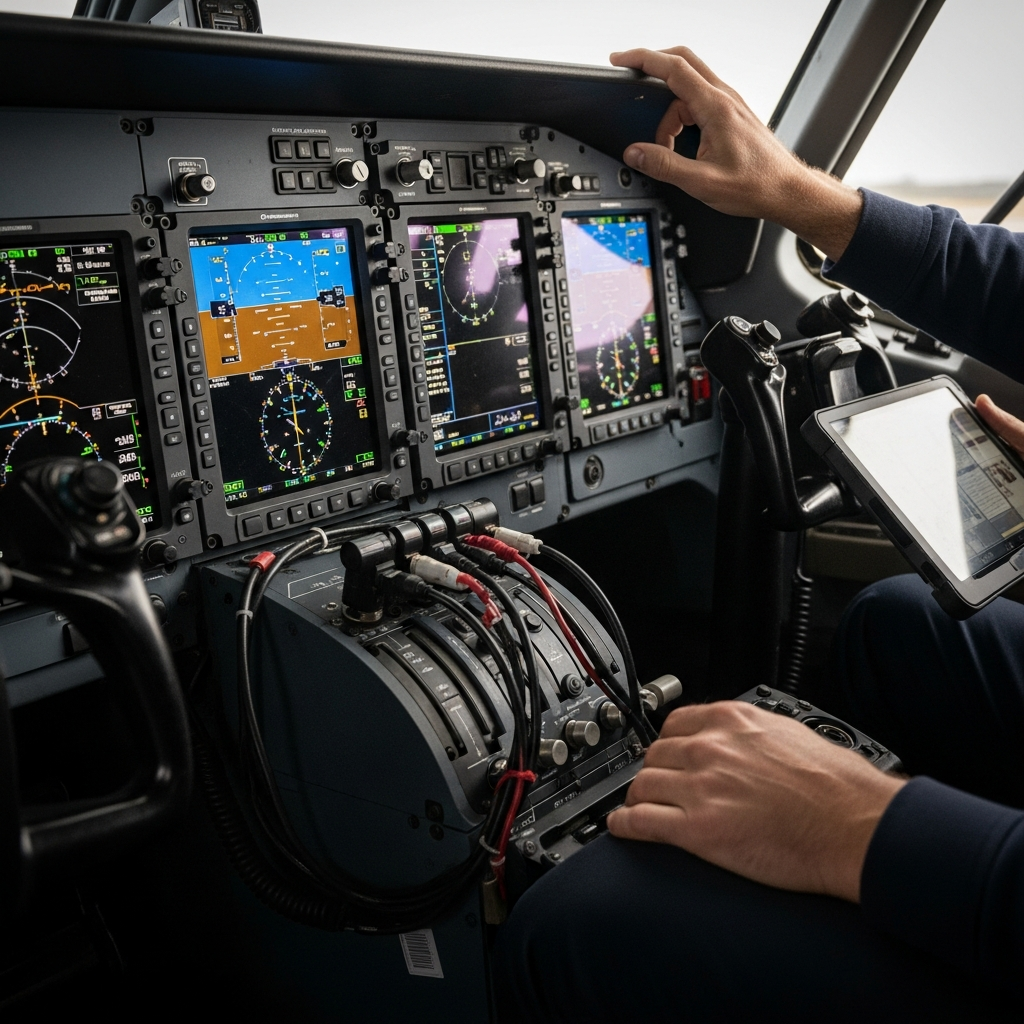
Eight years of working around Garmin glass cockpits has taught me that the G1000 NXi is absolutely the gold standard for GA retrofits. But that first week after installation? Brutal. I’ve met more pilots than I can count who thought their brand-new $80,000 avionics upgrade was dead on arrival because the PFD wouldn’t initialize. Honestly, it’s staggering how often I hear this story. The system’s fine most of the time — it’s the setup that’s broken.
G1000 NXi setup problems fall into predictable buckets, and nearly every one is fixable without shipping anything back to Garmin. I’m going to walk you through the exact troubleshooting sequence I’ve learned doing this on Cessna 172s, Piper Arrows, and Beechcraft Bonanzas — and trust me, each airframe has its own quirks.
Why G1000 NXi Setup Fails (And How to Spot It)
Before you panic, you need to know what actual failure looks like. Let me break down the five most common symptoms:
- Display won’t boot past the Garmin splash screen — You power up, get the trademark Garmin logo, and then nothing but black for 3+ minutes while your stomach drops into your boots.
- Autopilot module not recognized in System Status — The PFD boots fine, the MFD boots fine, but navigate to System > Status > Module Health and the GFC 700 shows as “not detected” or offline.
- Altitude and airspeed data dropout intermittently — Everything displays correctly for 30 seconds, then the altitude tape freezes and unfreezes, or airspeed reads zero before snapping back.
- Softkey buttons respond with 2–3 second lag or don’t respond at all — Tap the screen, nothing. Tap again, suddenly both taps register at once.
- Audio panel doesn’t recognize COM/NAV frequencies from the glass display — You tune a frequency on the PFD, but the audio panel shows something different or won’t lock in.
Probably should have opened with this section, honestly — knowing which symptom you’re actually experiencing cuts your troubleshooting time in half. I once spent two hours chasing a “module detection failure” that turned out to be nothing but a loose USB cable buried in the stack.
Step 1: Check Your Power Distribution Unit Connections
The G1000 NXi runs on 28 VDC power distributed through a Garmin GDU 620 or equivalent PDU. That PDU has seven connector ports on the back, and each one needs to be seated properly — not finger-tight, but actually properly.
Here’s where I start:
Walk to the back of your PDU, usually mounted in the avionics stack near the vacuum pump. You’ll see round connectors labeled PWR 1, PWR 2, CAN HIGH, CAN LOW, and discrete input lines. Each has a small red or black plastic collar. Grab that collar — not the wire — and gently pull straight out. You should feel resistance. If it slides out like it’s greased, it wasn’t seated correctly.
Look at the connector pins now. You’re hunting for discoloration, corrosion, or bent pins. A single bent pin breaks the whole handshake. See greenish or white buildup? Spray those pins lightly with electronics cleaner and let them air dry for five minutes. Don’t wipe them — you’ll smear corrosion around.
Reinsert each connector firmly until you hear or feel a click. The collar should rotate slightly as it seats. No click means it’s not fully inserted, and your system will think the module is offline despite having full power.
Here’s why this matters: the G1000 NXi talks to each module via CAN bus handshake. A loose connector means no handshake. The system doesn’t know if the module exists, so it shows “offline” in Status. You’ll restart six times convinced you have firmware corruption when you really just need to push harder on a connector.
Once all connectors are reseated, power the system back on. If your module detection issue was just a connector problem, Module Health will update within 30 seconds and you’re done.
Step 2: Verify CAN Bus Wiring and Module Handshake
The CAN bus — that’s Controller Area Network — is the nervous system of the G1000 NXi. It’s a two-wire twisted-pair network letting the PFD, MFD, GFC autopilot module, and peripherals all talk at 500 kbps. If that bus has noise or impedance problems, modules drop offline even when powered.
Your avionics shop should have run CAN HIGH and CAN LOW as a twisted pair with 120-ohm characteristic impedance, shielded separately from power and audio wiring. But I’ve seen retrofits where those wires run alongside the main power bundle, get pinched during panel installation, or sit too close to the vacuum line. All of those create electromagnetic interference that the CAN bus reads as a dead module.
What to check:
First, navigate on the PFD to System > Status > Module Health. Write down which modules show “Online” and which show “Offline.” If the autopilot module is offline but everything else is online, you’ve got a CAN bus segment problem hitting just that module.
Second, visually trace the CAN wiring from the PDU to the autopilot module. Look for sharp bends, pinch points, or crossings over power wiring. CAN HIGH and CAN LOW should run together twisted and shouldn’t cross power wiring at sharp angles. If they do, have the installer reroute them — at least 1 inch clearance from power bundles.
Third, check for proper termination. The CAN bus needs a 120-ohm resistor at each end of the network. Your avionics shop configured this during installation, but if someone powered down a remote module or unplugged a connector, termination might have shifted. Without it, CAN messages reflect instead of propagate, and your whole network becomes unreliable.
Seeing intermittent altitude or airspeed dropouts? Suspect CAN noise before you suspect sensor failure. A flaky CAN bus drops specific data packets randomly. The sensors are usually fine — the network is just noisy.
Step 3: Software Update Sequencing and Rollback
This is where I see the most expensive mistakes happen. Garmin pushes updates to the G1000 NXi in a specific order, and skipping steps or updating modules out of sequence creates what look like firmware corruption errors.
The correct update order is: PDU firmware → PFD unit firmware → MFD unit firmware → GFC autopilot module firmware → database updates.
Order matters because the PDU is the master controller. Update it first so it can properly initialize and communicate with slave modules. Update the PFD before the PDU and the two versions don’t match — the PFD might not recognize commands from the PDU during boot. You get a module detection failure that feels like a hardware problem but isn’t.
Already updated out of sequence and seeing phantom errors or repeated boot failures? Roll back. Connect your laptop to the G1000 NXi USB port, open Garmin Logon, and revert to the last known-good software version from 30 days ago. Garmin stores three previous versions on the unit. Rolling back takes about 90 minutes per module and almost always resolves corruption-related boot issues.
Don’t attempt this unless you’re confident with Logon software. One interrupted update during rollback can brick the unit — that’s a $15,000 repair bill and a grounded aircraft for two weeks while Garmin services it.
When to Call an Avionics Shop vs. DIY
There’s a hard line between smart troubleshooting and expensive mistakes.
You can safely handle: connector reseating, visual inspection of wiring, navigating System Status, and software updates — at least if you’ve done them before and have Logon software with proper Garmin account licensing.
You should not attempt: CAN bus continuity testing without proper equipment (that’s a $3,000+ network analyzer), bench diagnostics on the PDU itself, replacement of failed modules, or anything requiring breaking factory seals or removing firmware authentication locks.
Getting this wrong costs. A single bad continuity test or improper CAN termination degrades the entire network. You’ll think the problem is fixed, fly for three hours, and face intermittent failures at altitude. Or you’ll damage a module during diagnostics — that’s $8,000 to $12,000 replacement plus labor.
If you’ve reseated connectors, verified CAN wiring visually, checked Module Health, and nothing works, call your avionics shop. Budget $300 to $500 for bench diagnostics. That’s cheaper than making a wrong move.
Backup Instruments and Redundancy to Consider
The G1000 NXi is magnificent when it works. But you’re in an aircraft. You need backup.
Pair your glass cockpit with a mechanical backup airspeed indicator, a vacuum-driven attitude gyro, and an independent altitude source. Sounds analog and redundant — that’s exactly the point. If your glass system loses CAN bus power or develops a catastrophic software issue, these mechanical instruments keep you legal and safe.
Anemometer airspeed indicators and Weston attitude gyros are fully compliant with Part 23 regulations. They integrate into older instrument panels without any modifications to your G1000 NXi setup.
A standalone handheld GPS — the Garmin aera 660 works great — gives you backup navigation independent of the glass system. It runs 16 hours on batteries and costs about $1,200. Cheap insurance for a $100,000+ aircraft.
The G1000 NXi setup problems you’re facing right now are solvable. Most are connectors or CAN bus configuration, not actual failures. Follow the sequence I’ve outlined and you’ll have your system running correctly within a few hours. Hit a wall? That’s what avionics shops are for.
“`